
Google's Third Content Algorithm Update of the Year | Sites Relying on AIGC to Cut Costs and Boost Efficiency Are Facing a Traffic Cliff
Google rolled out its third spam content algorithm update of 2026, and many websites that previously used AIGC for SEO optimization have seen traffic plummet after this round of algorithm updates
More than three months ago, I predicted that in order to maintain its dominance in traditional search engines, Google would certainly take a new round of measures against AIGC before its own AI system could stand on its own.

Sure enough, in August Google released the August 2026 Spam Update. This is the third spam content algorithm update targeting content in 2026, following the updates in March and June.
Although Google did not loudly announce a new spam content policy or publish a related blog post, such intensive algorithm testing and updates targeting spam content are uncommon in Google's history.
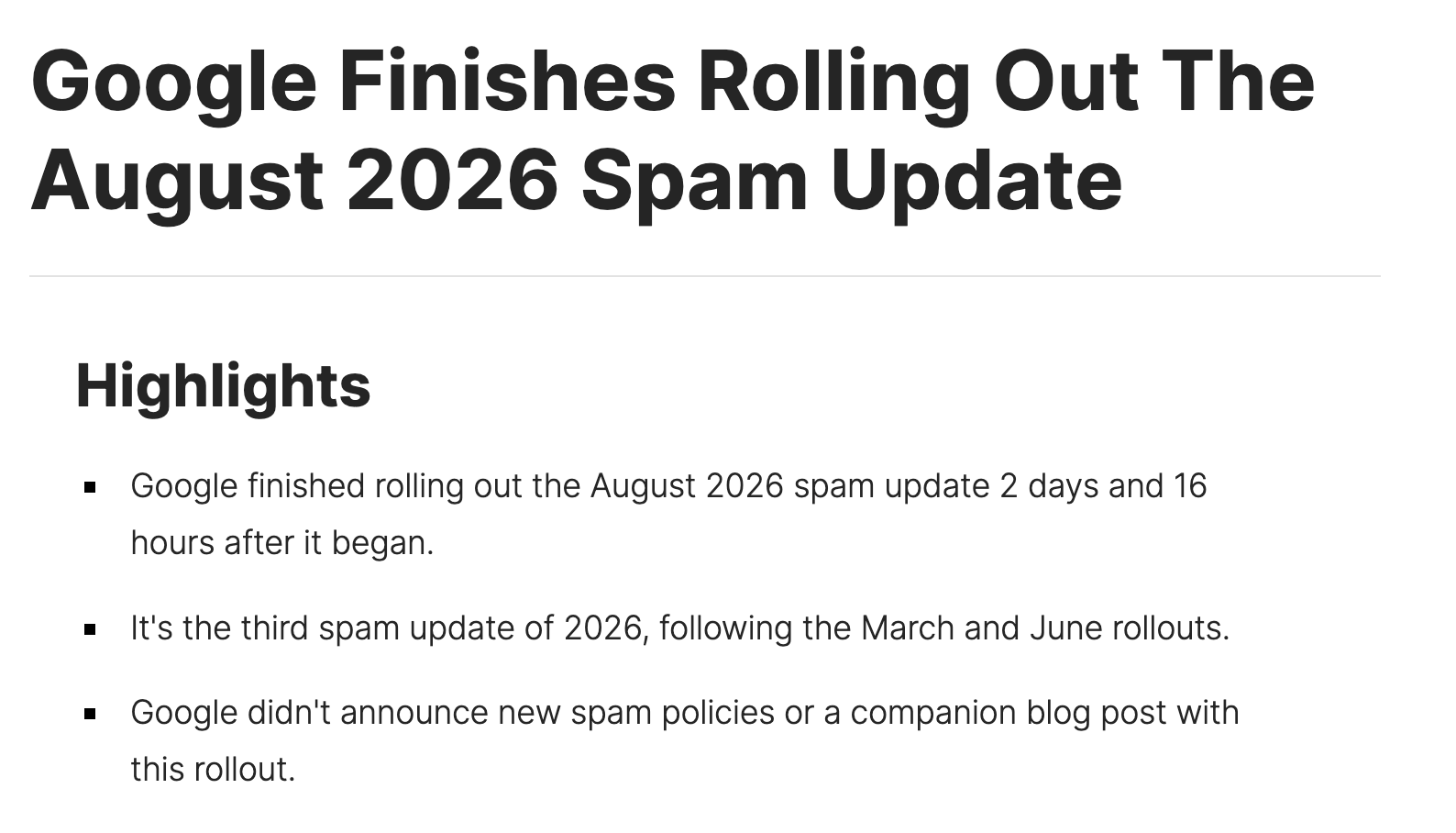
Image source: Search Engine Journal
On the Original Sin of AIGC: "The Fault Is Not in the Knife, but in the One Who Wields It"
After AI tools became widespread, the most dangerous sentence was: "AI can write anyway, so publishing more can't hurt." This sentence has trapped many companies in the "volume trap" and caused many SEO practitioners focused on content to "lose" their core competitiveness.
Many companies' decision-makers believe that AI can quickly generate content, and that publishing a dozen or dozens of articles a day will improve a website's index rate and earn good rankings. They cut their original content teams, let AI mass-generate content, and even skipped review entirely, dumping it straight onto their official websites.
The result: Websites become harder and harder to index, rankings keep dropping, traffic is cut in half, and they may even be demoted or penalized by search engines.
Why does this happen? Because search engine algorithms have become extremely mature at identifying AIGC. AI-generated content often shares common traits: empty, emotionless, data-free, timeless, context-free, lacking human thought and emotion, and without any core value. Such content is essentially "spam content." Search engines will not only refuse to index it, but will also mark websites that publish large amounts of spam content as "low-quality websites," further lowering their authority and rankings.
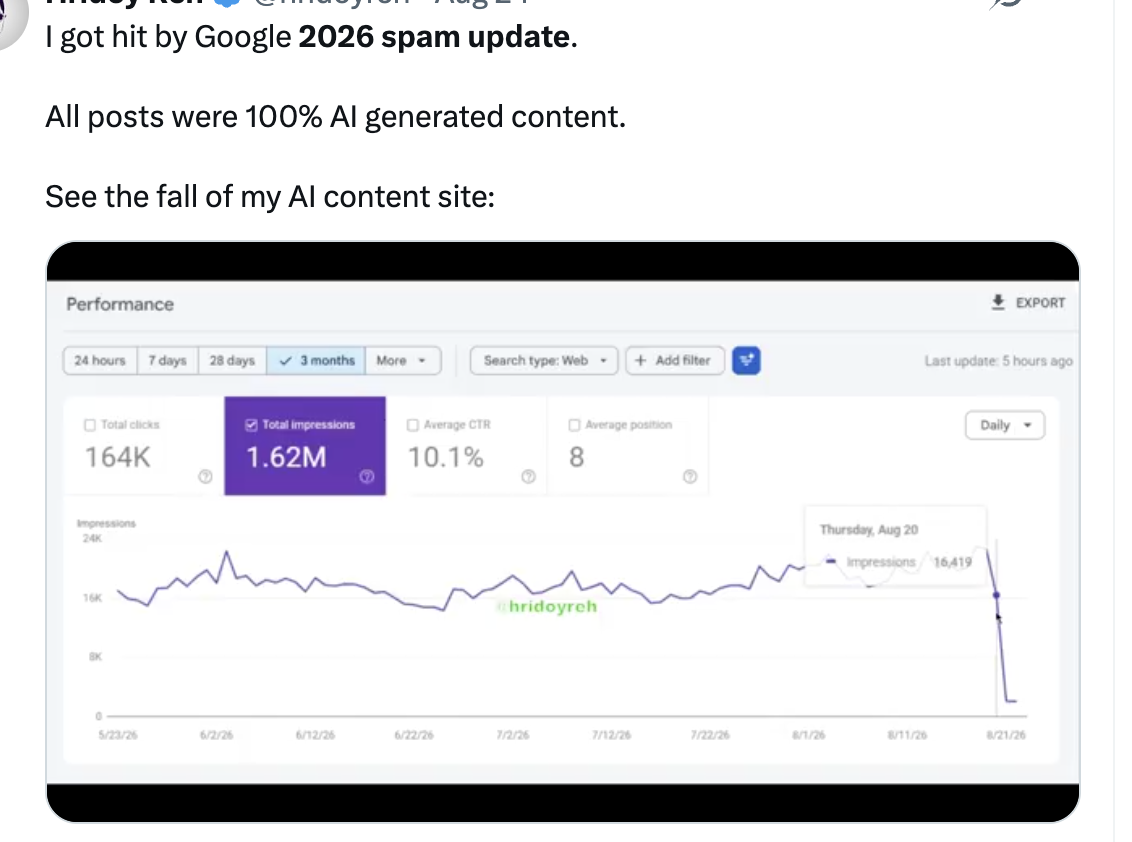
Image source: from X
This is especially true in fields like finance, tech, e-commerce, and healthcare, where timeliness and expertise are critical—pure AI content has almost no chance of breaking through. AI training databases lag behind, so they can't access the latest information in real time, and the content they generate often contains timeliness errors. At the same time, AI lacks specialized industry knowledge, so the content it produces may contain expertise errors. These errors not only hurt user experience but also get flagged by search engines as low-quality content.
Logical consistency without understanding the principles ≠ correct strategy
I once came across a financial news site whose owner, in order to cut costs, abandoned the original content team and switched to AI to mass-generate content. Dozens of financial news articles were published every day, all scraped, aggregated, and rewritten by AI from the web—no original viewpoints, no real-time data, no in-depth analysis. As a result, in just two months, the site's index rate dropped from 80% to 10%, all core keyword rankings fell off the first page, traffic was cut in half, and the site was even demoted by search engines, making it impossible to appear in search results.
By chance, a friend introduced us, and during the conversation the topic came up of how to restore the site's authority. I told him: "You used junk content to deceive search engines, so of course search engines will punish you. The core of SEO has never been 'having content'—it's 'having valuable content.' No matter how much junk content you produce, it can't change the fact that it's junk. Not only does it fail to bring traffic, it also plants landmines for your site."
Later, we helped them adjust their strategy: stop mass-producing AI content, rebuild an original content team, and focus on producing high-quality original content. Publish only 2-3 pieces per day, each one combining real-time financial developments, professional analysis, and real cases to ensure timeliness, expertise, and value. Delete all junk content from the site and submit it to search engines for re-review. The second step was to take remedial action on some of the existing AIGC. At the same time, we also needed to constantly monitor whether the authority chain and traffic chain were flowing smoothly.
After more than three months of effort, the site's index rate gradually recovered to over 78%, core keyword rankings returned to the first page, organic traffic rose steadily, and conversions improved noticeably. This case fully demonstrates that AI can help us boost content production efficiency, but it cannot replace the value created by an original content team.
Conclusion
In the age of AI, SEO is about content quality, not quantity. Rather than using AI to generate a hundred low-quality pieces, it's better to write one valuable original piece with care. Valuable content—with soul, information, and data—is what gets indexed by search engines, earns good rankings, retains users, and drives sustained traffic growth. Those who obsess over AIGC and believe that flooding the zone is enough to succeed at SEO will ultimately be eliminated by search engines.