
SEO, GEO, AIO, AEO, ASO: What's the Difference?
Five commonly confused search optimization acronyms are actually four stages of one pipeline plus a parallel track. We break down each battlefield using Ahrefs data on 863,000 keywords.
SEO, GEO, AIO, AEO, ASO: What's the Difference?
Part 1 · Background: In Three Years, Search Optimization Gained Four More Terms
In 2024, traditional search engine optimization required just one term: SEO.
In 2025, AEO and GEO emerged. In 2026, AIO burst onto the scene with the rise of large language models. Each term has inspired lengthy explanations and been hailed as the next big thing, yet none has clarified how they relate to one another.
So teams resort to trial and error. A single team, based on different interpretations, spins up three workflows: one chasing rankings, one restructuring content, one populating third-party platforms. The budget is split three ways, and none of the portions is enough to revamp existing articles to the point of visible results.
The problem isn't a lack of information—it's that these five terms are actually five locations on the same map, mistaken for five separate paths. This article first clarifies which territory each occupies, then examines why the same methodology plays out differently in China versus abroad.
Part 2 · Article: The Battlefields of the Five Terms Are Distinct
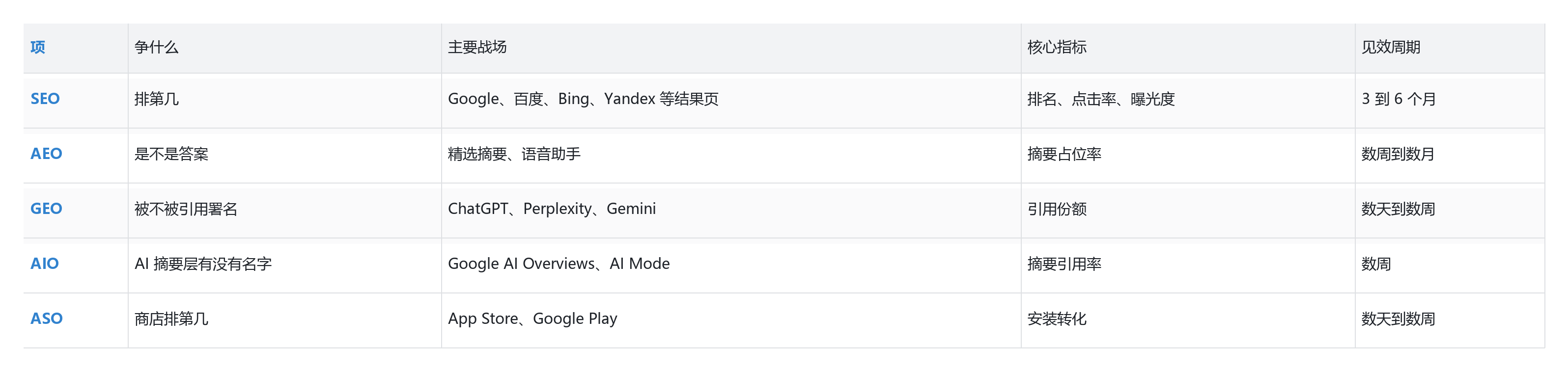 Difference 1: The first four are a pipeline, not parallel items
This is where most people go wrong. The order of the four terms is fixed: first you must be retrieved, then you can be extracted; extracted into an answer, then you can be synthesized; synthesized, then you can talk about ranking higher.
SEO addresses "can you be found," AEO addresses "can you be extracted," GEO addresses "will you be cited with attribution," and AIO addresses "do you have a name in Google's AI summary layer." If the previous layer isn't achieved, doing the next layer is futile. So there's no need to create a separate workflow for each term.
ASO is a separate parallel track, and it's the oldest of the five. ASO (App Store Optimization) didn't emerge with AI; it appeared around 2008 when app stores were taking off, before large language models existed—mobile app stores themselves were independent search gateways. It focuses on an app's search ranking and download conversion within the store, optimizing metadata and creative assets, not web pages.
Its constraints are completely different from SEO. iOS titles are 30 characters, subtitles 30, and the keyword field 100 bytes. In SEO, one article can cover dozens of long-tail keywords; in ASO, every character is a trade-off. And the stores have no public backlink formula — treating ASO as SEO in a different venue will leave you disappointed. The industry also has a usage that explains ASO as Agent Store Optimization, but that is a different mechanism entirely, with completely different character budgets and ranking signals. Don't conflate the two.
Difference two: AEO, GEO, and AIO are often treated as the same thing
These three are the easiest to confuse, but they operate on different battlefields.
AEO competes over "is it the answer", targeting the passage in a featured snippet and the sentence a voice assistant reads aloud. What you optimize is the extractability of the answer: put the conclusion at the start of the paragraph, 40 to 60 characters, with a complete subject-verb-object; write Q&A as explicit headings plus short answers; write comparisons as tables. What the system needs is an answer that can be extracted without rewriting the whole page and that stands on its own.
GEO competes over "will it be cited with attribution", targeting whether ChatGPT, Perplexity, and Gemini mention your name when generating a response. What it optimizes is how the model weighs sources when synthesizing multiple ones — a brand-level matter.
GEO is the only one of the five terms backed by peer-reviewed experiments. The concept comes from "GEO: Generative Engine Optimization" by Aggarwal et al., published at KDD 2024 (arXiv:2311.09735), a collaboration between Princeton and IIT Delhi, using 10,000 queries across 25 domains to build the GEO-bench benchmark. One of the metrics measured is called PAWC — the position-weighted word count of your content cited in the answer. The conclusions are direct: adding authoritative quotations +41%, replacing vague statements with concrete numbers +38%, adding credible external sources +35%; keyword stuffing is −8%, a negative return. The paper also found that smaller sites benefit more from GEO than large ones.
AIO is about winning "a name in the summary layer of Google's AI Overviews and AI Mode" — the narrowest battlefield, covering only Google's own AI layer. The term itself is ambiguous: another usage is as an abbreviation for AI Optimization, broadly meaning being visible across all AI interfaces, which is essentially an extension of GEO with no independent boundary. When discussing AIO, be clear about which sense you mean.
A simple way to distinguish them: AEO sits close to the page, GEO sits close to the model, and AIO sits close to a specific feature layer of a specific platform.
Difference three: the goals of SEO and GEO have already diverged
This is the most practical change in 2026. The two used to overlap heavily; now they don't.
In its March 2026 update, Ahrefs sampled 863,000 keyword SERPs and 4,000,000 AI Overviews URLs. The result: only 37.9% of cited pages also ranked in the organic top 10, 31.2% ranked between 11 and 100, and the remaining 31.0% ranked outside the top 100 or were not in the index for that keyword at all. Eight months earlier, the first figure was still 76%.
The mechanism behind this is query fan-out. Google splits a user query into several sub-queries, retrieves for each separately, and then synthesizes an answer from multiple sub-result sets. A page doesn't need to rank for the original term; it only needs to provide the best answer for one sub-query under that sub-query. The result is that traditional ranking reports no longer show most of the AI citation surface.
While we're at it, let's correct a widely circulated claim: "fresh content is cited 4.3 times more often in AI search." No primary source can be found. Ahrefs measured 16,975,000 cited URLs: the average age of AI-cited content was 1,064 days (about 2.9 years), versus 1,432 days (about 3.9 years) for the Google organic top 10 — a difference of 368 days, or about 25.7%. It's real and reproducible, but it's not a multiple.
Example: after clarifying the boundaries, we merged three workflows into one
Let's walk through our three toughest commercial terms (AI Agent directory, Agent marketplace, Agent Skills). These three terms rank between 14 and 22 in Search Console — impressions but no clicks; meanwhile, when people ask ChatGPT and Perplexity "which AI Agent platforms are worth using," none of the six platforms mentioned is us.
The original three tracks were merged like this: one called grabbing head terms, one called restructuring content, one called building presence on third-party platforms.
After the merge, step one is to rework existing pages rather than add new content. Existing pages already carry authority, so reworking them is far more cost-effective than writing something new: at the top of each page, add 3 to 5 self-contained conclusions; turn feature descriptions from "supports multi-turn dialogue" into Q&A pairs like "Can this Agent handle multi-turn dialogue, and which models does it support?"; and for performance figures, add test conditions, sample size, and timing. A parameter table that only says "fast response" won't be cited by models, because they can't verify it. Add FAQPage and Article schema, and state clearly within the first 150 words who we are, what we do, and who we serve. Once this step is done, the foundational conditions for all four targets are in place at the same time.
Step two is to shift from grabbing head terms to covering sub-queries. Export from Search Console every query with impressions but ranking outside the top 20, group them by intent, and build one satellite page per group — covering exactly the sub-query surface that query fan-out expands into.
Step three is to create an original asset that can be cited. For example, "We analyzed pricing and latency data for 1,200 public Agents and arrived at these 7 patterns." Content like this is inherently citable, and it also serves as a backlink vehicle. All 90 of our articles are purely introductory; what gets cited for competitors falls into three types: hands-on comparison pages with pricing and latency data, technical documentation pages that explain their positioning, and real review citations on third-party platforms. At the time we had none of the first two, and weren't doing the third.
The fourth step is to measure separately. Traditional organic search looks at rankings and CTR; AI citation share looks at the mention rate and position of a fixed set of 20 target questions across engines, retested on a fixed monthly cadence; sub-query coverage looks at how many sub-queries have a page in the top 10; third-party sources look at performance on high-authority platforms, which is a slow variable. If you only look at the first item, three months later the data shows no change, and we conclude that "the AI stuff doesn't work" and pack it in — when in reality citation share is rising, it's just invisible in traditional reports.
Part Three · Domestic and Overseas: One Underlying System, Two Source Ecosystems
Once the five terms are clear, there's another question: does the same method still hold domestically? The underlying principles are the same; the source ecosystems are completely different.
Overseas, the source structure is relatively open, and the five source centers are essentially Reddit, YouTube, Wikipedia, Perplexity, and Google itself. YouTube accounts for 18.8% of Google AI citations and 13.9% of Perplexity's; Reddit is the number one source for overseas AI citations. Ahrefs' study of 75,000 brands also found that brand mentions on YouTube correlate most strongly with AI Overviews visibility — stronger than backlinks. So the focus is on producing original assets that third parties can cite.
But this landscape is still shifting and shouldn't be treated as settled. GEO is new, and both source selection and citation logic are still iterating fast. Reports suggest that in September, AI citations of Reddit content fell 86.4% month over month, showing that the "number one source" position is not secure. At the same time, Google keeps expanding its own AI footprint: Search Console has added generative AI retrieval data, and multimodal search is being tested in parallel. Put another way, today's popular playbook may need to change within months, but the underlying logic doesn't: content has to stand up on its own before AI is willing to put its name to it.
In China, the landscape is dominated by walled gardens. Doubao favors Toutiao and Douyin, Ernie Bot favors Baijiahao and Baidu Baike, and Tencent Yuanbao favors WeChat Official Accounts; neutral platforms like DeepSeek and Kimi do not favor their own ecosystems—if your technical depth is sufficient, you can get in. This picture synthesizes multiple third-party tests from the first half of 2026, mainly CSDN's thousand-query test in March, the mid-June report on a 5×7 engine source-weight matrix, and a platform comparison based on 16,800 real queries. These are third-party test results, not official disclosures; their precision is lower than first-hand overseas research, so use them as order-of-magnitude references rather than precise conclusions.
Here is a counterintuitive point. Multiple tests show that self-built content on official websites has a citation rate that stays in the middle range across major engines, and no engine treats official websites as a high-weight source. The speculation is that AI engines are generally wary of self-built sites from interested parties and prefer to cite independent third-party sources. The share of China's GEO budgets spent purely on official website optimization should decline; the same budget spent on third-party sources yields better results. This is completely opposite to the overseas view that "self-built in-depth content is most effective," and it is where the difference between China and overseas is greatest.
Timeliness requirements also diverge by engine. Some tests claim that Doubao gives the highest weight to content from the previous 1 to 2 weeks, with citation rates dropping noticeably after a month; while DeepSeek is still citing solid technical posts from several months ago. A single content calendar cannot satisfy all engines at once; they need to be scheduled separately. In addition, some tests claim that the probability of the definition sentence in the first paragraph of a Baijiahao article being directly cited exceeds 70%, and that Tongyi Qianwen's citation rate for table content is about 47% higher than for ordinary paragraphs. I have not found first-hand papers or official disclosures for these two figures, so I recommend re-testing them yourself before use.
Translate into actions. Overseas markets: focus on original data and in-depth content that can be cited by third parties, with the official website as the carrier and YouTube as a supplement. Domestic market: focus on professional UGC and technical content on high-weight third-party platforms, with the official website relegated to a landing page for reception and conversion. If you operate in both, maintain one official website to the strictest standard, because Google's crawlability requirements and domestic engines' preference for structured content do not conflict—conclusion-first structure, tables, numbered lists, and clear hierarchy work on both sides.
Summary
The relationship among the five terms is four layers plus one line. SEO, AEO, GEO, and AIO are, in order, "can you be found, can you be extracted, will you be credited, do you have a name in the AI layer of a given platform"—if you fail at the earlier one, the later one is wasted effort. ASO is the parallel track of app stores, not on the same chain as web optimization.
The difference among AEO, GEO, and AIO lies in distance from the model. AEO sits close to the page, with the answer block as its goal; GEO sits close to the model, with citation and attribution as its goal; AIO sits close to a specific feature layer of a specific platform, the narrowest battlefield of all. When discussing AIO, you need to specify which usage you mean.
SEO and GEO have already diverged in their goals. Ahrefs' figure dropped from 76% to 37.9%, and traditional ranking reports no longer capture most of the AI citation surface. In execution, you need to shift from chasing single-point rankings to covering sub-queries.
Once you draw these distinctions, three workflows can merge into one. Rework existing structure, spread out across sub-queries, build citable original assets, and measure across four lines. The next step is just one thing: this week, pick 20 existing pages and rework their structure, then build a monthly baseline of citation share for 20 target questions.