
After Working with 100+ Clients Who Needed SEO, I Finally Realized: SEO Runs Deeper Than You Think
After Working with 100+ Clients Who Needed SEO, I Finally Realized: SEO Runs Deeper Than You Think: many people's understanding of SEO is far too one-sided, and with the spread of AI tools, even more people misunderstand SEO on a deeper level
Since starting the business, I've had to talk to new prospective clients every single week. Some days I speak with 5+ clients in a day—calls, proposals, walkthroughs back to back—trying to explain the most abstract concepts and principles in the simplest possible terms.
One day, I spoke with three clients in a single morning:
The first one opened with: "How long does your SEO take to get to the first page? How many keywords can you guarantee in the top three? How many inquiries can you bring in per month?"
The second: "Do you have case studies in our industry? Send them over so I can see the results. We only want to work with vendors who've done projects for our peers."
The third was even more direct: "My budget is exactly this much—only 3,000 yuan. Tell me if you can guarantee results. My ask isn't high: just get my website to the first page for specific keywords within a week, and give me a result."
These clients come from different industries, but from their questions you can tell their understanding of SEO is very one-sided, and the questions themselves are enough to give you a headache.
After hanging up, I did the math: over the past five-plus months, I've spoken with roughly 100 SEO clients, one after another.
After talking with 100 clients, my biggest takeaway isn't "how big this market is"—it's that most people's understanding of SEO is still stuck in the advertising mindset of a decade ago. You think you're buying traffic, but you're actually buying into a completely different logic and methodology.
Today I'm writing down the 7 most common misconceptions I've seen across these 100 clients. If you're planning to do SEO, or you're being spun in circles by all kinds of vendors, this article might save you half a year of detours.
1. "Do SEO with an advertising mindset—just copy the strategy"
Many clients start right off with "How soon will it work?", "How long to get to the first page?", "Can you guarantee rankings?", "Can you make sure 100 keywords rank in the top three?"...
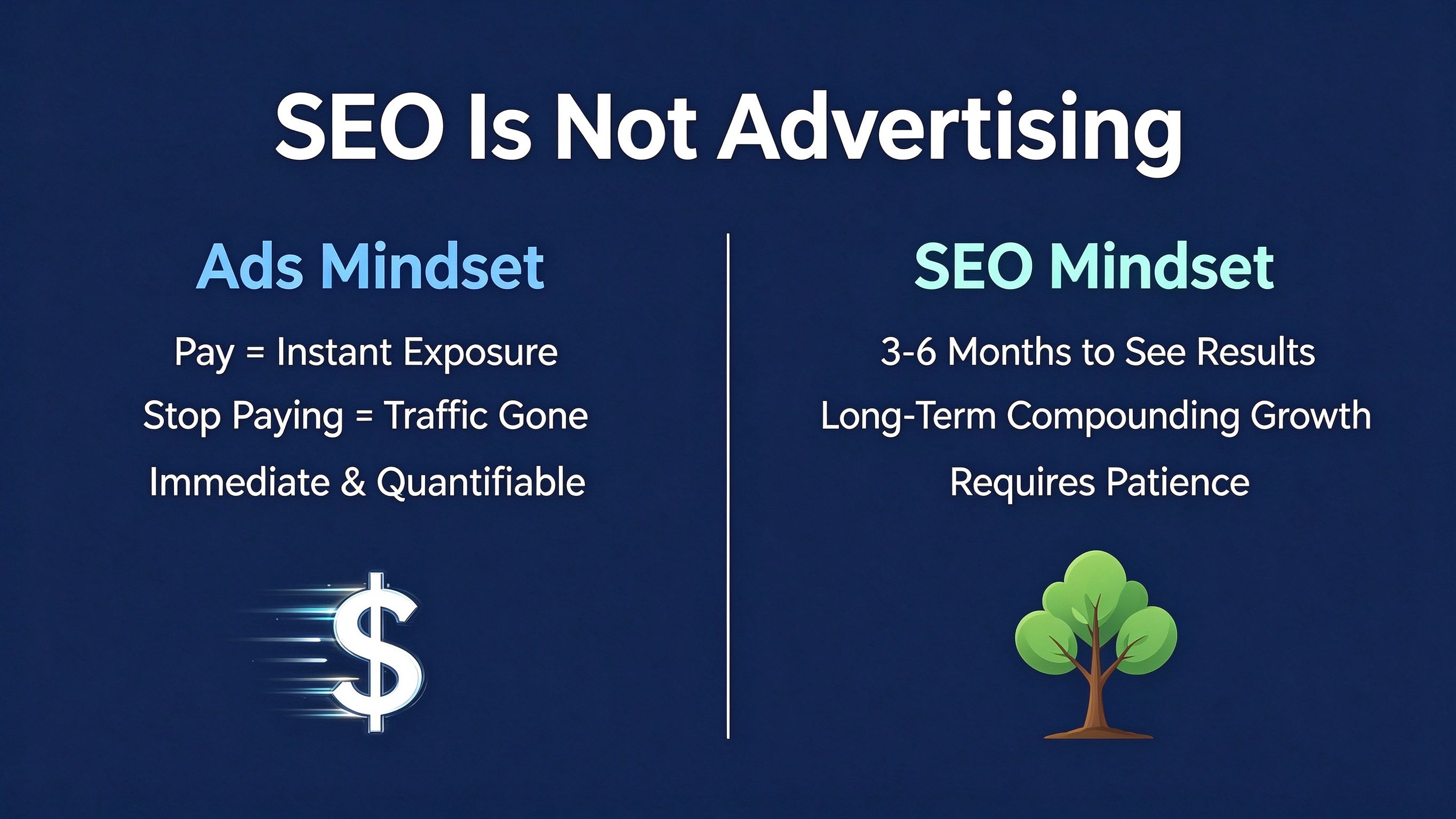
This is a classic advertising mindset. With feed ads or PPC, you pay and you get impressions; stop paying and traffic stops. The results are immediate and quantifiable. But that's a short-term, quick-win approach, whereas SEO is the exact opposite—it's a long-term play. Advertising is more like fishing; SEO is more like farming fish.
SEO is about slowly "raising" your website within the rules of search engines until it becomes a site worth recommending. Its payback period usually starts at 3 to 6 months. For the first three months, you might only see the number of indexed pages rising and impressions climbing, while inquiries barely move.
An Australian client we took on in August was exactly like this. The first two weeks were mainly patchwork infrastructure work, and the client's boss got a bit impatient: "How come there's still no movement after so long?"
Because this client had previously been burned by a supplier from India, he naturally didn't trust me either. But I wasn't worried at all, because as long as you stick to the right approach, everything else is just a matter of time. By the third week, both impressions and clicks shot up... and because the base was small, after the authority chain and traffic chain were repaired, the growth even exceeded my expectations. Later, this client also handed me another project to manage.
I once told a client: SEO isn't a vegetable you plant today and harvest tomorrow. It's more like growing a tree. The first two years are about putting down roots; the fruiting period comes later.
But most people aren't willing to wait. They hold SEO to the KPIs of paid advertising. After two months without inquiries, they feel they've been scammed, then switch to another supplier and start over. Switching back and forth, they spend a lot of money, and the website is still the same website.
2. Only Want to Copy Competitors, Not Think
"Send me some case studies you've done for competitors in our industry." I've heard this sentence no fewer than 30 times, and that's no exaggeration.
The client's logic is simple: if you can make it work for our competitors, just do the same thing for our website.
But the problem is, you can't replicate a competitor's path to success:
Every website differs in domain age, historical authority, content foundation, brand voice, competitive landscape, product level, and more. The keywords a competitor ranks for might take you half a year and still not rank, because they've been sitting in that position for three years, while you're a latecomer with no brand voice at all—so naturally the strategy is different. What's worse, many clients haven't even figured out their own website's core keywords, yet they demand "do the same as our competitors."
The same Australian client—after a very strong first month, their boss came back with specific demands: target the keywords they'd seen from competitors, and publish at least 4 articles per week for each of those keywords. I gritted my teeth and followed the boss's instructions. The impressions that had been climbing steadily started to drop. In a weekly meeting, the boss's wife asked, puzzled: "Why was the growth so good before, and now that we've switched keywords, it's immediately not working? Is there any way to reverse this decline?"
"SEO isn't about copying someone else's homework. The key is to figure out our strengths, what our customers are searching for, and who our competitors actually are. The top players in the same industry aren't necessarily our competitors—they're targeting the high-end segment, while we're doing downstream products. Different keywords, different strategy," I replied.
"We followed their advertising approach before, and the results were pretty good."
So that was the root of the problem, I thought to myself. Because they'd succeeded by replicating their past advertising experience, they wanted to do the same with SEO.
I tactfully explained that the drop in impressions was mainly caused by the mid-course strategy change. Fortunately, the boss's wife was reasonable and allowed me to run things my own way. After the strategy was restored over the following two weeks, the previous upward momentum resumed.
Summary:
You can reference what peers are doing, but what you reference is the methodology, not the results to be copied directly.
3. "I only want inquiries, not process data"
"I don't care how many impressions or clicks you get—I only want inquiry volume."
That sounds reasonable enough—who isn't in business for the final deal?
But the problem is, inquiry volume is the result, not the starting point.
Search engine traffic is a funnel: impressions → clicks → visits → inquiries → deals. Every layer has a conversion rate. Skipping the earlier layers and demanding only the last one is a bit like saying, "I'll skip elementary school, middle school, and high school—I'll go straight from kindergarten to university."
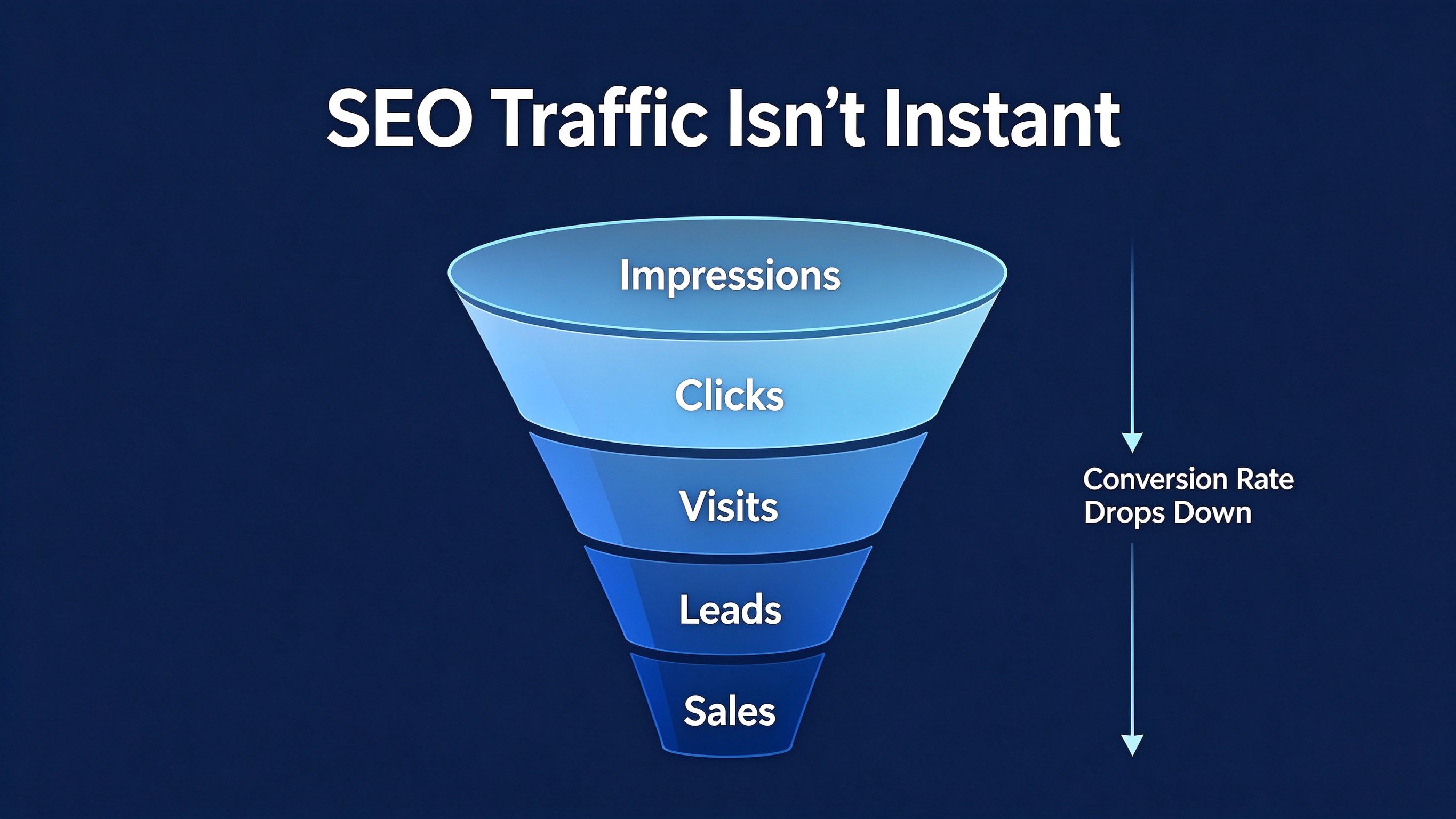
Many clients see impressions rising in GSC data but inquiries not rising, and conclude that SEO is useless.
But they don't realize that after impressions go up, it takes one to two months for rankings to stabilize, then click-through rates to pick up, and only then does inquiry volume start to rise.
We had a client we worked with for three months. In the third month, we got their traffic and clicks up—impressions nearly doubled, and clicks rose by over 70%. But their team felt it wasn't bringing in enough inquiries, so they cited budget constraints and stopped working with us. Even after we parted ways, I stayed in touch with their boss, and occasionally he'd ask me about SEO.
Then, toward the end of the fourth month, he suddenly said: "We haven't been doing SEO lately, but inquiries have picked up. What's going on?"
I told him: "That's the long-tail effect from the sustained effort over the previous three months. But if you don't continue with SEO now, this momentum probably won't last long."
He didn't believe me—he just thought the market had improved.
A little over a month later, he came back looking defeated: "You were right. Looking at the backend now, impressions and clicks are both declining, and daily inquiries are almost zero." He wanted to restart the SEO engagement, but by then I was stretched thin on time and had to politely decline.
Summary: Judging SEO solely by inquiry volume is like looking only at the thermometer instead of the body temperature. You can't judge your health by a single number at the end—you have to check whether the chain of indicators in between is healthy.
4. Believing AIGC Can Directly Replace Original Content
This is the most concentrated misunderstanding this year, and the excuse most bosses use to "cut costs and boost efficiency."
Almost every month, a client asks me: "AI writing is so cheap now—why do we still need you for content SEO? Can't we just use ChatGPT to generate content in bulk?"
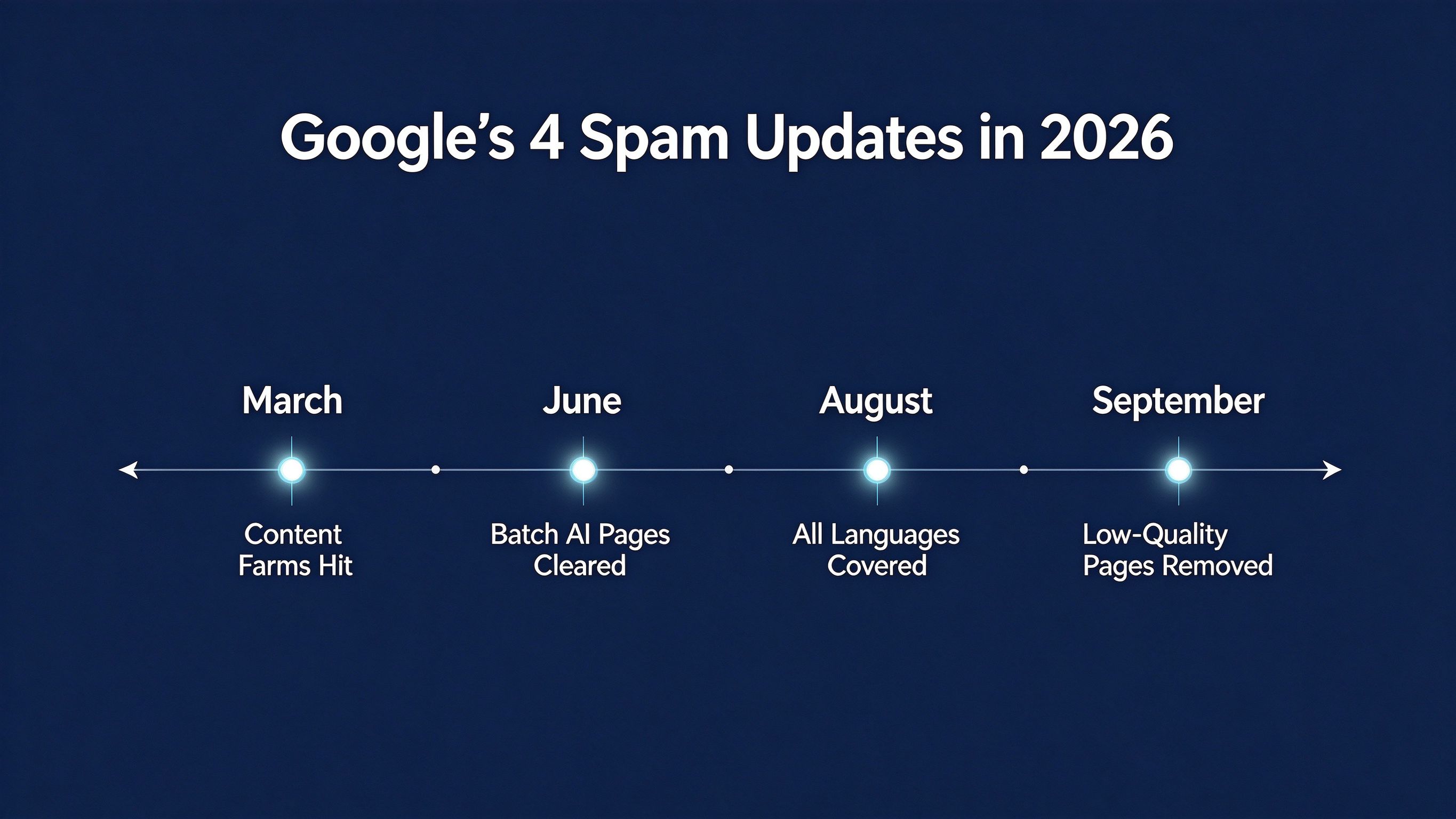
Every time, I remind them of one thing: Google has rolled out four spam content algorithm updates this year—one in March, one in June, one in August, and one in September. Each one targets low-quality, mass-generated content that offers no real value to users.
Google isn't saying AI content can't be used. What it's cracking down on is pages mass-produced for rankings that read like correct nonsense but are utterly useless to users. Something like "my grandfather's son is my father, my father is my grandfather's son, I am my father's son, and all three of us are male"—padding out word count with zero substance.
If you use AI to churn out 100 generic product descriptions, chances are you'll be wiped out in the next algorithm update. After Google's third spam update this year, some sites saw fairly large-scale traffic drops—precisely because they had relied heavily on AIGC for SEO content optimization in the earlier stages.
In reality, truly effective content SEO means AI assists and humans make the calls. Humans understand the business, understand user pain points, and know which information is genuinely valuable to customers. AI can help you improve efficiency, but it can't replace human experience and understanding of the business.
5. The vicious cycle of distrust toward vendors
This phenomenon is quite interesting.
When the data looks bad, clients question your ability: "Are you guys actually any good?" "My friend says another company gets better results."
When the data improves, clients start doubting again: "Is this data real?" "You're not faking it, are you?"
Either way, there's no trust.
Why does this happen? Because the SEO industry really is murky. Too many people have ruined the market with black-hat tactics, data manipulation, and short-term speculation. Once clients have been burned, they become wary of every vendor. Overall, it's the industry's vendors exploiting information and knowledge gaps to make dirty money, which has done terrible damage to the entire industry's reputation.
But think about it from the other side: if the vendor you choose does legitimate white-hat SEO, then data fluctuations are simply normal—algorithms update, competitors ramp up, and your own content quality rises and falls. You can't demand the kind of certainty from SEO that you get from advertising, where "pay and it works."
Trust is extremely expensive in the SEO industry. Because it's not a one-off transaction—it takes a three-to-six-month cycle to see results. If you don't trust me and I don't trust you, in the end nobody gets anything done.
6. Thinking you can hire a professional SEO for one or two thousand yuan
"How much do you charge for SEO per month?"
"Can you do it for two thousand?"
Every time I hear that price, I don't know how to respond.
In first-tier cities like Beijing, Shanghai, Guangzhou, and Shenzhen, a content SEO specialist with over two years of experience typically earns around 15,000 yuan a month. Technical SEO is even harder to hire for—salaries are generally above 20,000 yuan a month, and you need someone who genuinely understands code, crawlers, and page rendering.
You want to spend one or two thousand yuan to hire a professional to handle full-site SEO for you?
That's not realistic.
Yes, there are SEO services out there for one or two thousand yuan a month. But think about it — at that price, they still need to make a profit, so what can they actually do for you? Most likely, they'll mass-produce backlinks, mass-produce spun content, and use tools to fake some metrics. It might show short-term results, but in the long run, you're just waiting to get hit by an algorithm penalty. These kinds of vendors are probably just looking for a one-off gig, not a long-term business.
SEO is labor-intensive work. Writing content, doing research, modifying code, analyzing data — each of these requires time and professional judgment. A cheap price always corresponds to cheap effort.
7. Technical SEO can be handled with AI tools on your own
The last misconception often comes from clients with some technical background.
"I'll just crawl the site with Screaming Frog, run the report through an AI tool, and I'll know what's wrong, right?"
Tools can help you find problems, but finding problems and solving them are two different things.
Many clients get a tool report listing a bunch of issues: slow page load, duplicate content, missing title tags, missing structured data. But they can't tell the priority of these issues — which to fix first, which to fix later, whether fixing one will affect other pages, and how long to monitor after the fix.
More importantly, what AI tools can detect are mostly basic, generic issues. Truly complex technical SEO problems — like indexing anomalies caused by JavaScript rendering, weight distribution in internal link structures, or conflicts with canonical tags — aren't things AI tools can directly give you answers to.
The value of technical SEO isn't in "how many problems you can find," but in "knowing which problem is currently the biggest bottleneck affecting rankings, and how to fix it without causing side effects."
Final thoughts
I've written all this not to say that SEO clients are difficult to deal with.
On the contrary, I understand how these misconceptions come about. Too many people in this industry have packaged SEO as a miracle cure that "guarantees first-page rankings and guaranteed leads," setting client expectations sky-high, and then failing to deliver.
Clients aren't ignorant — they've just been burned too many times.
But conversely, if you're genuinely committed to SEO, one thing worth getting straight will save you a lot of money: SEO isn't advertising. It's a long-term undertaking that demands patience, expertise, and sustained investment of time. Approach it with an ad-spend mindset, and you'll most likely be disappointed. Approach it with a product-building mindset, and in three to six months you'll see completely different results.
After talking with 100 clients, I've found that the ones who ultimately succeed and get results are rarely the ones with the biggest budgets — they're the ones most willing to understand how SEO actually works, give it time, and adapt along the way.